
The Musical Elements
A Framework of Learning

Music is indeed a unique subject. Akin to magic, the effects of music on the brain and body are not fully understood. My approach to music education is to EMBRACE and CENTER the transcendent, spiritual, and mysterious qualities of the subject and allow students to encounter it in their own time. I have often found the disaggregation of musical elements to be a tricky proposition. “Music” is only really happening when all of these forces combine into the fully realized expression. Lately, however, I’ve been experimenting with ways to direct student attention towards the elements, allow them to experience them in some sense of isolation, and strengthen their skill. In this post I’ll share some of these strategies! But first…
Housekeeping:

Did you know that you can create over 250,000 different Dalcroze-style movement activities with the MAKE IT MUSIC card decks? Besides that, it cultivates in YOU an instinct to adapt and respond to YOUR students, thinking on your feet and seeing possibilities for creative expression. Have you not ordered your copy yet? It’s available now on AMAZON or through our website at make-it-music.com.
From the Archive:
The Four Poses: Review

In January of last year I posted a video of an extended demonstration, teaching my patented Four Poses lesson with public school kids. The video has gotten a ton of views and is one of the few full Dalcroze lesson demonstrations you can find on YouTube. Even the legendary teacher Jack Stevenson commented positively on it! (Hi Jack!) In this post I’ll re…
Analyzing a joke is like dissecting a frog. You might learn something… but the frog definitely dies. - E.B. White
This quote has always struck me as true, not only for humor, but certainly in music. One of the things I love about the Dalcroze work is how it preserves the wonder and mystery of music. When we separate music into its various elements, there is a tendency to lose the magic. An exercise that is meant to teach a concept is often devoid of the magic that would make it recognizable as music. I have struggled with this inclination in my own teaching! How do I focus student attention on specific skills and concepts without losing the beauty and expression that I find so important?
The key thing to understand about musical elements, is that they don’t exist in isolation. The way the elements INTERACT is critical to their result. Like a chemical formula, each element is vital to the final product of a musical experience.
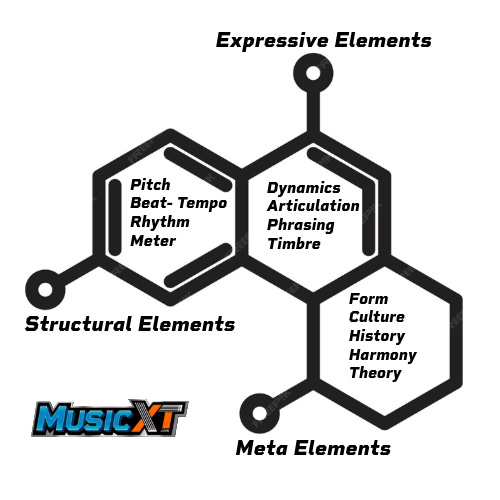
I divide the elements into three categories:
Structural Elements
These are skills like pitch, beat, rhythm, and meter; without which the end result would not resemble music in the most basic sense. For children, there is a temptation to become “stuck” in this category, and it’s understandable. There is a lot of emphasis on the most basic skills that are developmentally appropriate.
Expressive Elements
Dynamics, articulation, phrasing, and timbre represent musical choices that are critical to a musical sensation. I would argue that ALL music contains some representation of this category, even if it is done thoughtlessly. For instance, not changing the dynamic level in any way doesn’t meant there AREN’T dynamics… it just means you aren’t capitalizing on the expressive possibilities of the category. When the musician gains comfort with manipulating expressive elements, it makes a big difference in the perceived result.
Meta Elements
These are elements that are not always conscious, but have a huge impact on the context within which the music “makes sense.” It’s possible to perform a piece with no knowledge of theory, history, culture, or form… but you won’t fully understand WHY your music is perceived the way it is or how to maximize the impact.
A Lesson Formula
But how can you work on the Structural Elements in a developmentally appropriate way but not sacrifice the Expressive and Meta elements, thereby preserving the musical sensation for the students? By rooting the Structural Element in physical experience, it becomes possible to isolate them in an effective way before integrating them back into a musical context.