
TacoCat Palindrome Activity: Sequencing and Play
A fun song and game that explores Palindromes, rhythmic and linguistic

I am always looking for inspiration—for engaging ideas that will really capture kids’ attention. As an offhand comment in one of my classes, I brought up the concept of palindromes. These are little word games in which a sentence or a word is spelled the same forward as backward. A few years ago, “tacocat” was all the rage in elementary schools as a meme. But to my surprise, the kids in my school had no idea what a palindrome was and had never heard of tacocat.
That got my wheels turning.
I decided this was a pretty fertile area to explore, and I started building a lesson around it. There’s something about the combination of language, pattern, and a little bit of humor that felt like it could really land. In this post I’ll share a sequence, a song, and a game that ended up making palindromes surprisingly fun—and surprisingly musical—to practice. But first…
Housekeeping:
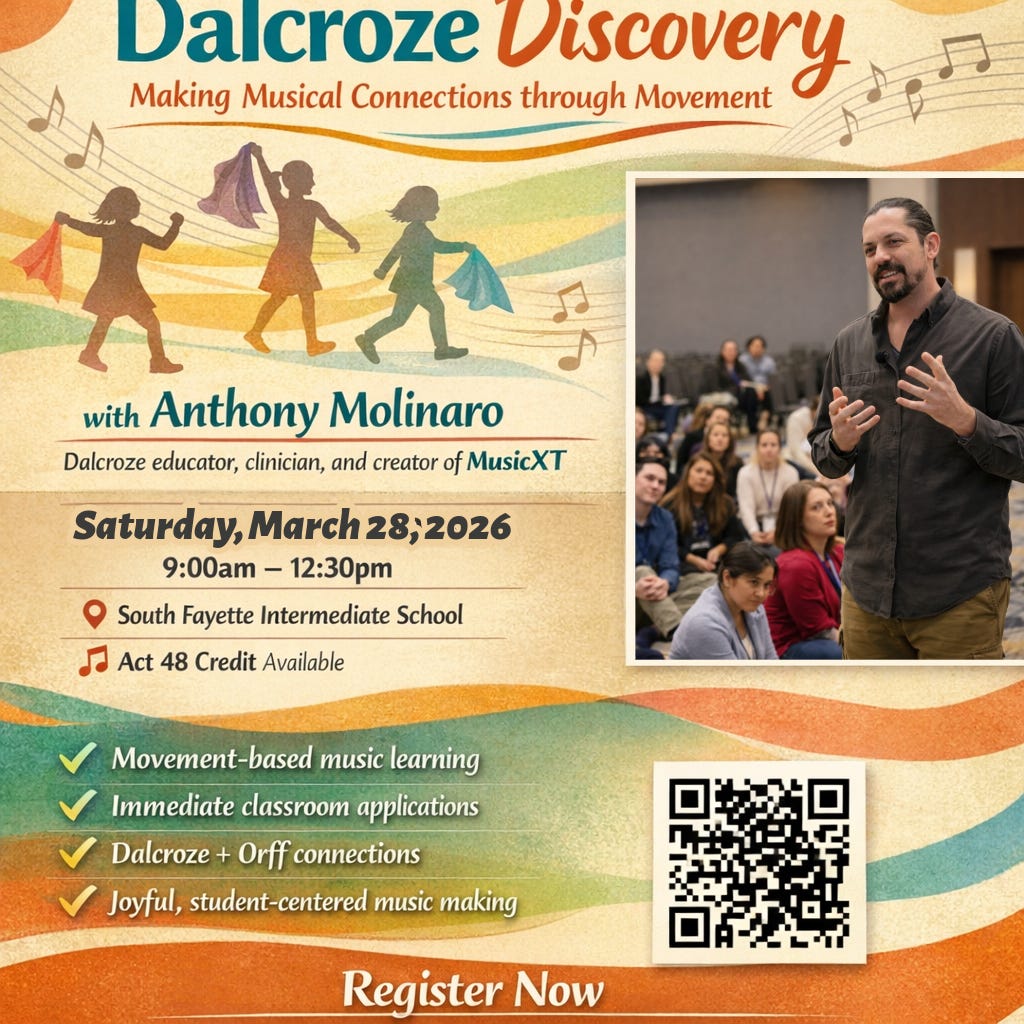
You should come to this THREE HOUR workshop experience right here in Pittsburgh, PA!
And don’t forget about MAKE IT MUSIC! This book and card deck is designed for ALL music teachers to play with Dalcroze principles in their classroom.
From the Archive:
Stepping Rhythms

One of my strongest recollections of my childhood Eurhythmics classes involved stepping rhythms. Something about moving your whole body through space and time creates an unforgettable memory! The body WANTS to move in time. Harnessing this natural inclination to establish a “groove” with the body and WILL the feet to establish the groove of your intention is a primary goal of any Dalcroze practice. Managing weight and momentum makes rhythms feel more expressive and connects them to sensation, rather than simply to abstract ideas like “counting” or duration. If you’ve been following me for very long you know I have an aversion to counting music, and lately I have been making an effort to scrub my lessons of ANY numbers. In this post I’ll lay out a CLASSIC Dalcroze sequence that results in students performing a rhythm in a highly assessable format. But first:
I’ve always thought palindromes were interesting. There’s something kind of mind-bending about them. In fact, my brother, a well-regarded violinist and composer, once wrote a piece that was entirely a palindrome—music that reads the same forward and backward. It’s such a cool concept, and I had a feeling the kids would get a kick out of it if I could bring it into their world in a concrete way.
So I started with rhythmic palindromes.
We clapped and stepped a few simple rhythmic patterns. Nothing too complicated at first—just enough to establish a clear sequence. Then I instructed the students to try to perform the rhythms backward. That alone was a fun challenge. You could see them thinking, retracing, sometimes laughing when it didn’t quite line up.
If you watch the video, you can see how it sequences logically and naturally. First forward. Then backward. Then we combine the two to create a full palindrome: forward + backward as one continuous pattern.